
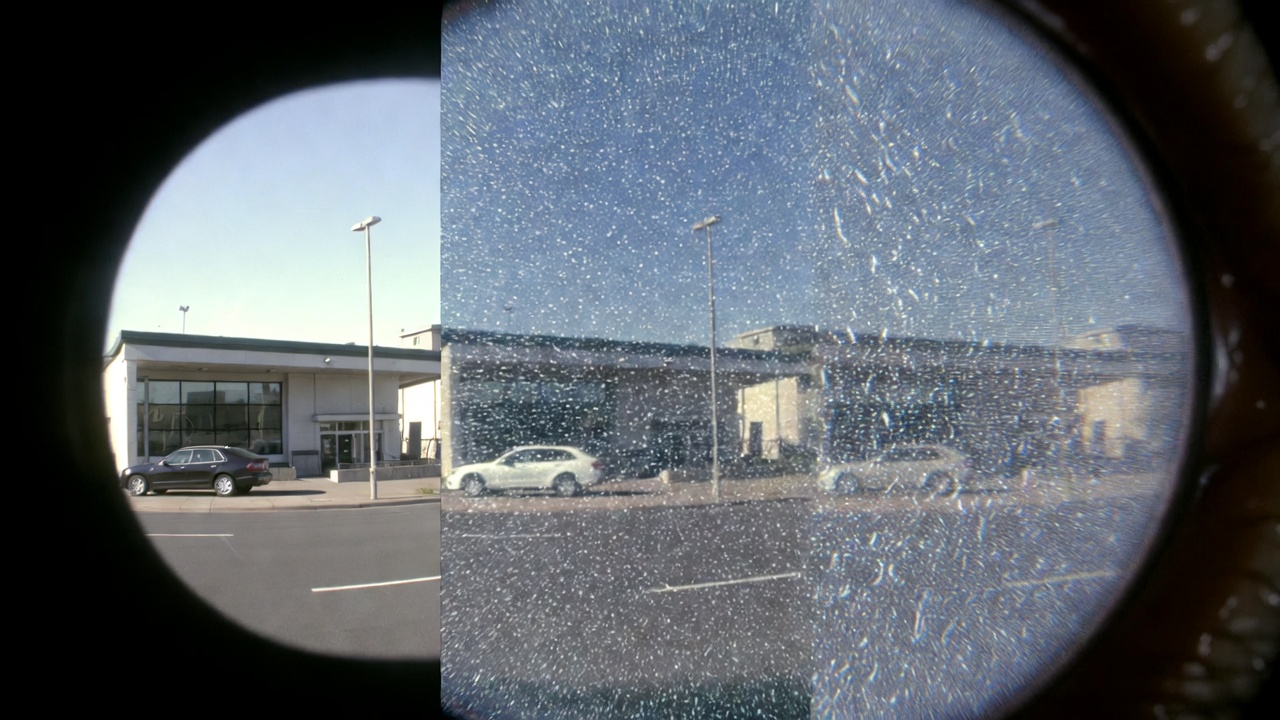
Visual Snow Syndrome (VSS) is a neurological visual condition characterised by the persistent perception of static-like flickering, dots, or visual noise across the entire visual field in both eyes and in all light conditions, including darkness and with the eyes closed. The name derives from the resemblance of the visual disturbance to the static noise seen on an analogue television with no signal. Unlike visual disturbances caused by eye disease, the static in visual snow is not produced in the eyes themselves but arises from abnormal neural activity and processing in the visual cortex, making it a central neurological condition rather than an ocular one.
The full symptom profile of Visual Snow Syndrome extends well beyond the core static-like visual noise. Associated symptoms frequently include palinopsia, which refers to prolonged visual afterimages where an image continues to be perceived in the visual field after the original object has moved or disappeared, photophobia and severe light sensitivity particularly to bright, fluorescent, and flickering light sources, nyctalopia and difficulty seeing clearly in low-light or night conditions, visual trailing where moving objects appear to leave a smear, trail, or ghost behind them, entoptic phenomena including floaters, blue sky scintillations, and geometric patterns perceived in the visual field, depersonalisation and derealisation creating a sense of unreality or visual disconnection from the environment, and in a substantial proportion of patients, co-occurring tinnitus (persistent ringing or noise in the ears) and migraine with or without aura. The combination of these symptoms can be profoundly disabling and significantly affects concentration, daily functioning, and quality of life.
The exact cause of Visual Snow Syndrome is not fully understood, but current neuroimaging research points toward a state of cortical hyperexcitability in the visual processing regions of the brain, particularly the lingual gyrus and cuneus, where abnormal levels of neural activity produce intrusive visual experiences. Associated conditions include migraine (present in the majority of VSS patients), anxiety, prior concussion or head injury, post-viral syndromes, and in some individuals, the long-term use of certain medications. Visual Snow Syndrome is entirely distinct from hallucinogen persisting perception disorder (HPPD), which has a different clinical profile, different neurological mechanism, and different associations. Accurate differential diagnosis is important to ensure that the correct management approach is pursued.
Visual Snow Syndrome is significantly underdiagnosed in India. Because the condition is neurological in origin and the structures of the eye appear normal on standard examination, many patients are told that their vision is fine and that nothing can be done. Others complete consultations with multiple specialists across ophthalmology, neurology, and psychiatry without receiving a coherent diagnosis or a management plan. Awareness of VSS among general eye specialists and neurologists in India is gradually improving, but many patients still experience a prolonged, distressing diagnostic journey before receiving an accurate specialist assessment.
At Caring Vision Therapy in Chennai, we provide specialist neuro-optometric evaluation for patients with suspected or confirmed Visual Snow Syndrome. The assessment includes detailed measurement of visual field extent and sensitivity, contrast sensitivity at multiple spatial frequencies, assessment of light sensitivity and photophobia thresholds, evaluation of associated visual processing functions, and a thorough clinical history to characterise the full symptom profile and identify any associated conditions that require coordinated management.
Neuro-optometric management of Visual Snow Syndrome at Caring Vision Therapy centres on reducing visual stress and cortical hyperexcitability through evidence-informed approaches. These include optometric syntonics phototherapy using light frequencies selected to modulate the cortical visual response and reduce the neural hyperexcitability associated with VSS, precision tinted lenses and chromatic filters selected to manage photophobia and reduce the subjective severity of visual static and light sensitivity, structured vision therapy to address any co-occurring binocular or oculomotor deficits that are amplifying visual discomfort and fatigue, and practical advice regarding environmental modifications, screen display settings, lighting adjustments, and activity management strategies that reduce symptom burden in daily life. Where co-occurring migraine or neurological conditions require attention, we work collaboratively with neurologists and headache specialists.
It is important for patients with Visual Snow Syndrome to approach treatment with realistic expectations. Current interventions do not eliminate the visual static in most patients, and VSS is a chronic condition that requires ongoing management rather than a single course of treatment. However, many patients experience meaningful reduction in the overall burden of their visual symptoms, improved tolerance of visually demanding environments, and significant improvement in daily functioning and quality of life following a structured neuro-optometric management programme. If you are experiencing persistent visual static, light sensitivity, afterimages, visual trailing, or other symptoms consistent with Visual Snow Syndrome, contact Caring Vision Therapy in Chennai or Hyderabad to arrange a specialist neuro-optometric evaluation and discuss the management options available to you.
Related Reading