


Learning-Related Vision Care
Reading, attention and school difficulties caused by weak eye teaming, focusing or tracking.
Evidence-based vision therapy in Chennai for children and adults, trusted by 20,000+ patients across India, delivered by FCOVD/FOVDR-certified neuro-optometric specialists.
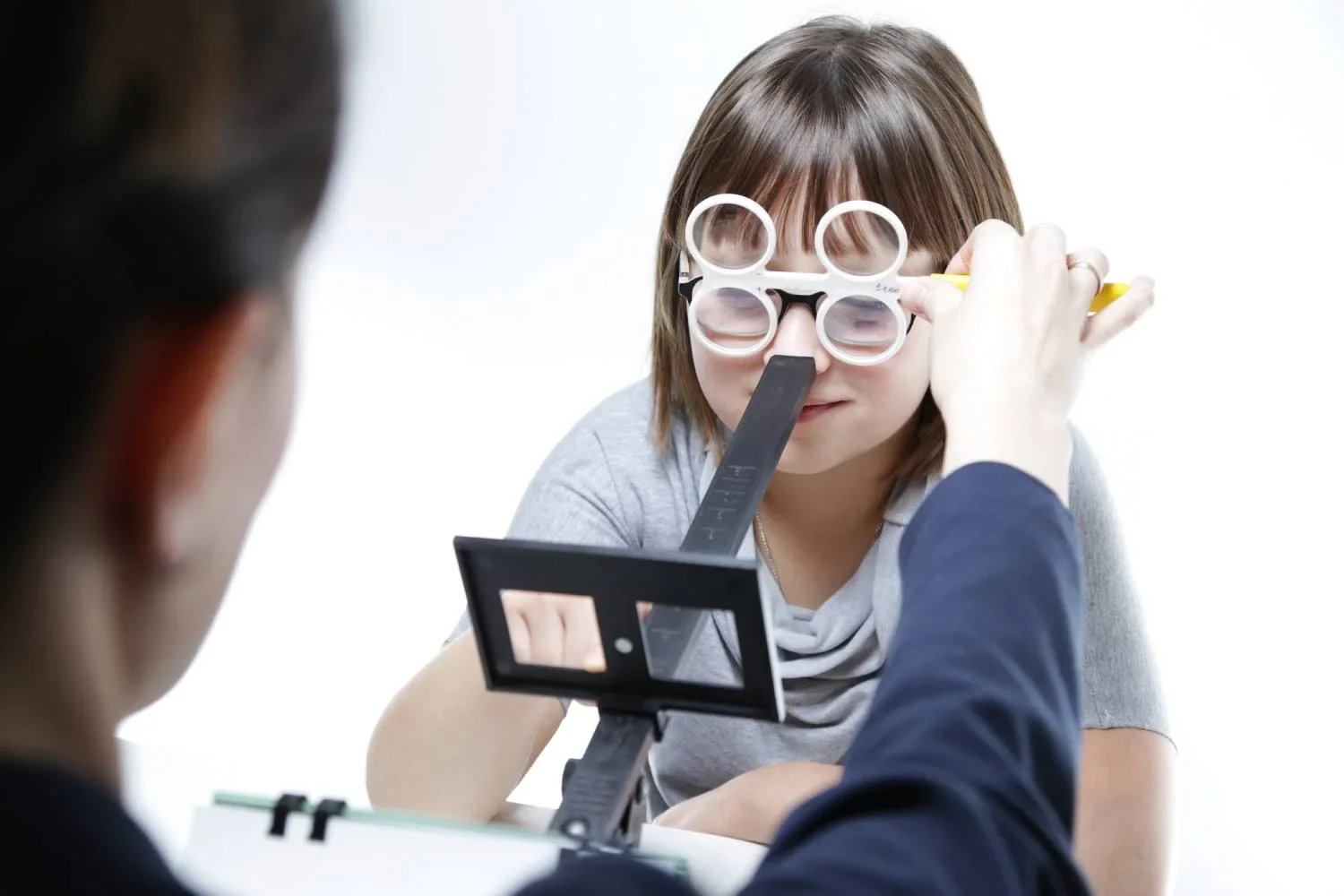
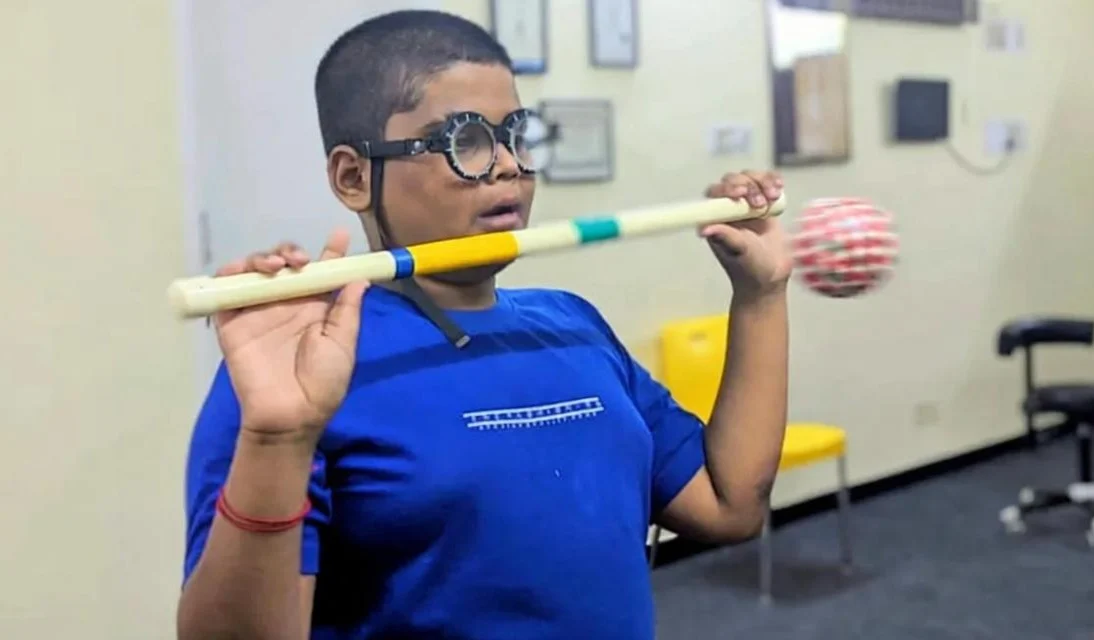
Vision therapy is a supervised programme that retrains how the eyes and brain work together - eye teaming, focusing, tracking and visual processing. It treats problems that glasses cannot, because glasses correct clarity while vision therapy corrects coordination. A child can have perfect 20/20 eyesight and still have a vision problem that makes reading exhausting.
Choose the closest match. We'll show you what we usually check and where to begin.
For reading and school
Many children who skip lines, read slowly or avoid homework have good eyesight but weak eye teaming, focusing or tracking.
What we usually check
For lazy eye and squint
Lazy eye and many squints can be treated with vision therapy, often alongside glasses and with or without patching. It is not too late after age seven.
What we usually check
For rising spectacle power
If your child needs stronger glasses every year, that is myopia progressing. Myopia management aims to slow it down, not just update the glasses.
What we usually check
For autism, ADHD and developmental delay
Vision affects eye contact, attention and how a child takes in the world. We adapt every assessment to the child, and work alongside their other therapists.
What we usually check
For adults after a brain injury
Double vision, a missing side of vision, dizziness in busy places or trouble reading are common after a concussion or stroke, and often improve with rehabilitation.
What we usually check
For screen strain in adults
Tired, red or painful eyes after a short time on a laptop are often a focusing or eye-teaming problem that ordinary glasses do not fix.
What we usually check
For families outside Chennai
Families across India and in 20+ countries work with us online: a video assessment, a home programme, and regular reviews. Some tests still need one clinic visit.
How it works
Drag the divider across your child's homework. The left side is how you see it; the right side is how a child with an eye-teaming, focusing or tracking problem may see the same page.
Ravi packed his bag and ran to the gate. The school bus was late again, so he sat on the wall and opened his reading book. The words were small, the page was long, and the bell would ring at nine. He read the first line twice, then lost his place again.
Double vision. The two eyes stop pointing at the same word up close, so print doubles or overlaps. Often convergence insufficiency.
Moving words. The eyes jump instead of gliding along the line, so words seem to drift. A common sign of eye-tracking problems.
Blurs after a while. Print starts clear, then blurs as the focusing muscles tire. A sign of accommodative insufficiency.
Skipping lines. The eyes lose their place, skip a line or go back to one already read. See why children skip lines.
Words crowding. Letters seem to run together and words are hard to pick apart. Often linked to learning-related vision problems.
An illustration to explain the idea. Every child experiences it differently.
Nine quick questions about what you notice at home and at school. Many children with 20/20 eyesight still struggle with reading and focus because of undetected functional vision problems.
Eye tracking · Why children skip lines
Reading stamina · Slow reading and vision
Focusing and eye teaming · Eye strain from screens
Eye teaming · Double vision while reading
Binocular vision · When one eye is struggling
Eye alignment · Squint treatment
Visual attention · Trouble concentrating on reading
Visual processing · Learning-related vision problems
Distance vision · See how myopia blurs the board
A guide for parents, not a diagnosis. Only a functional vision evaluation can confirm a vision problem.
Programmes for children and adults, in clinic in Chennai and Hyderabad or online across India. Each one is built around the person, not the condition.
Reading, attention and school difficulties caused by weak eye teaming, focusing or tracking.

Non-surgical treatment for lazy eye and squint, and myopia management to slow rising spectacle power.

Visual processing and eye-teaming therapy for autism, ADHD, cerebral palsy and learning differences.

Rehabilitation for vision problems after stroke, concussion or brain injury.
For adults & complex needs
Neuro-optometry treats problems in how the eyes and brain work together, whether present from childhood or caused by a concussion, stroke or brain injury. A standard eye test checks eyesight, not visual function, so these problems are often missed.
Who neuro-optometry helps
We take the time to understand what is actually going on before we recommend anything. Here is what care with us looks like, step by step.
We assess how your eyes and brain work together across 20+ clinical parameters. This goes well beyond a standard eye test and gives us a clear picture of what is actually affecting your vision.
Your programme is built around your specific findings, your age, and what you want to achieve. We do not use off-the-shelf plans because no two patients present the same way.
You will know how you are progressing at every stage. We track outcomes regularly, adjust the programme as needed, and validate results through clinical assessments before and after therapy.
Every programme is planned and reviewed by our two founders, who lead a team of specialist therapists in Chennai and Hyderabad.
 Rabindra Kumar Pandey
Founder & Optometric Director · Since 2010
FCOVD/FOVDR · FAAO · MCOptom (UK) · NORA
Rabindra Kumar Pandey
Founder & Optometric Director · Since 2010
FCOVD/FOVDR · FAAO · MCOptom (UK) · NORA
 Priya Pandey
Co-Founder & Clinical Director · India's first FCSO
M.Optom · MCOptom (UK) · FCSO (USA)
Meet the full team
Priya Pandey
Co-Founder & Clinical Director · India's first FCSO
M.Optom · MCOptom (UK) · FCSO (USA)
Meet the full team





"Vision therapy at Caring Vision Therapy genuinely changed how I see the world. As a mental health professional, I understand the science - and the results exceeded my expectations."
Lazy eye · age 4
"We found out that our daughter had lazy eye when she was 4 years. Her vision was very less even with glasses on… After an year of continuous sessions, her eye sight has greatly improved (with glasses). We were so happy to see such a drastic improvement."
Gunasheela MurukasanParent · Google review
Reading & writing
"We were worried because our son mixed up words while reading and writing. At Caring Vision Therapy, the team handled him with so much patience. Slowly his reading improved and writing became clearer."
Maya SinghParent · Google review
Autism
"We started therapy 1 year ago for my then 5 year old son on spectrum and we have come so far. His tracking has improved tremendously and also sits longer for other therapies… and also helping him to start reading."
Sakshi AggarwalParent · Google review
Developmental delay
"It's been 6 months since I'm bringing my daughter who has global developmental delay. After coming for sessions at Caring Vision, I find overall improvement in her vision, tracking & focus."
Roshni AmbroseParent · Google review
Screen strain · adult
"Even short amount of screen time feels very irritating and painful… I have consulted multiple big hospitals across India but there was no relief… I undergone the treatment prescribed by her and seen remarkable improvement."
Akash KumarPatient · Google review
Travelled from Russia
"I came from another country (Russia) because there is no offline vision therapy in my country. After an initial diagnosis, Rabindra Sir explained the cause of my problems and offered a personalized therapy program."
Vsevolod TuchinPatient · Google review
Individual results may vary based on diagnosis, therapy plan, and clinical adherence.
Yes. A standard eye chart tests only distance clarity and does not assess how well the eyes work together. Many children who pass school vision tests still have convergence insufficiency, poor eye tracking or accommodative (focusing) dysfunction, which cause slow reading, loss of place, poor concentration and avoidance of homework. When a reading difficulty has a visual cause, evidence-based vision therapy treats it directly, and many children read more fluently and comfortably once their eyes work together. A functional vision evaluation is the only way to identify or rule this out.
Line-skipping is a common sign of eye tracking problems. When the eyes cannot move smoothly along a line of text, the child loses their place, re-reads the same line, or skips ahead. This is a clinical sign of oculomotor dysfunction that responds well to vision therapy for children.
Most vision therapy programmes at Caring Vision Therapy run for 12 to 36 weekly in-clinic sessions depending on the condition and its severity. Convergence insufficiency typically responds within 12-16 weeks. Amblyopia and strabismus programmes are usually 24 to 36 weeks. Formal outcome measures are assessed at regular intervals throughout the programme.
Yes. Caring Vision Therapy offers structured telehealth vision therapy for patients across India and in 20+ countries. Sessions are conducted via secure video consultation, supported by guided home-based exercises, making specialist care accessible from anywhere.
Yes. Caring Vision Therapy has specialist in-clinic facilities in Chennai (Ashok Nagar and Anna Nagar) and Hyderabad (Jubilee Hills). Telehealth vision therapy consultations are available across India - including Delhi, Mumbai, Bangalore, Noida, Pune, Kolkata, and Pondicherry - and internationally, including the UK, UAE, USA, Australia, and Singapore.
A standard optometrist measures eyesight and prescribes glasses. A certified vision therapist is a specialist trained in the neuroscience of visual function - diagnosing and treating binocular vision dysfunction, oculomotor dysfunction, and related conditions through structured neuro-optometric rehabilitation programmes. Our team holds internationally recognised FCOVD/FOVDR, FAAO, and NORA certifications.
No. You can book a functional vision evaluation with us directly. If your child already has reports from an ophthalmologist, paediatrician or school, bring them along - we read them alongside our own findings and work together with your child's other doctors and therapists.
It depends on why the glasses were prescribed. Vision therapy trains eye teaming, focusing and tracking; it does not change the eye's power, so a child who wears glasses for short-sight or long-sight will usually still need them. For some focusing and eye-teaming problems, reading glasses can be reduced after therapy. If your child's power keeps increasing every year, ask us about myopia management.
Absolutely. Visual processing disorder and binocular vision dysfunction are not limited to children. Adults - including those recovering from traumatic brain injury, concussion, or stroke - benefit greatly from neuro-optometric rehabilitation. The adult brain retains significant neuroplasticity for functional vision improvement.
Caring Vision Therapy in Ashok Nagar, Chennai is India's only exclusively dedicated vision therapy and neuro-optometric rehabilitation centre. Since 2010 we have delivered pediatric vision therapy in Chennai for children who struggle with reading, eye coordination and learning, alongside adult neuro-vision care. A second Chennai clinic serves North Chennai at Anna Nagar East, and our Hyderabad clinic is in Jubilee Hills.
Plot No. 1134, 1st Floor, 16th Avenue, Ashok Nagar, Chennai 600083
Mon–Sat 9:00am–8:00pm · Sunday closed
Sri Arcade, Old No. 106, New No. 91, Plot No. 666, 1st Main Road, D Block, Anna Nagar East, Chennai 600102
Mon–Sat 9:00am–8:00pm · Sunday closed
Flat No 401, IVY Terrace, Plot No 119, Kavuri Hills Rd, CBI Colony, Jubilee Hills, Hyderabad 500082
Mon–Sat 9:00am–8:00pm · Sunday closed
Not near a clinic? Meet us online.
Telehealth consultations anywhere in India and in 20+ countries. How online vision therapy works
Call or WhatsApp any clinic +91 96936 30033
Book an in-clinic appointment in Chennai or Hyderabad, or consult via telehealth vision therapy from anywhere in India or abroad.
Ashok Nagar & Anna Nagar, Chennai • Jubilee Hills, Hyderabad • Online across India and 20+ countries