If your child has been diagnosed with amblyopia (lazy eye), the first thing most people hear is: patch the good eye. And patching does serve a purpose. But if that is all you are doing, there is a good chance you are missing the bigger problem.
At Caring Vision Therapy, we see a steady stream of children who have patched for months or even years, improved on the eye chart, and then lost that improvement shortly after stopping. The reason is straightforward: patching forces the weaker eye to work harder, but it does not teach both eyes to work together. That is a fundamentally different goal, and it requires a different approach.
What Is Amblyopia, Really?
Amblyopia is not a problem with the eye itself. The eye is structurally normal in most cases. The problem is in the visual pathway from the eye to the brain. One eye has been suppressed or underused during the critical period of visual development, so the brain never learned to process signals from it properly.
That distinction matters a lot. If the problem is in the brain's processing, then covering the good eye and forcing the weak eye to see is only a partial answer. You are stimulating the eye, but you are not necessarily training the brain to use both eyes together at the same time - which is what binocular vision actually requires.
The Limits of Patching
Acuity Improves, Binocularity Often Does Not
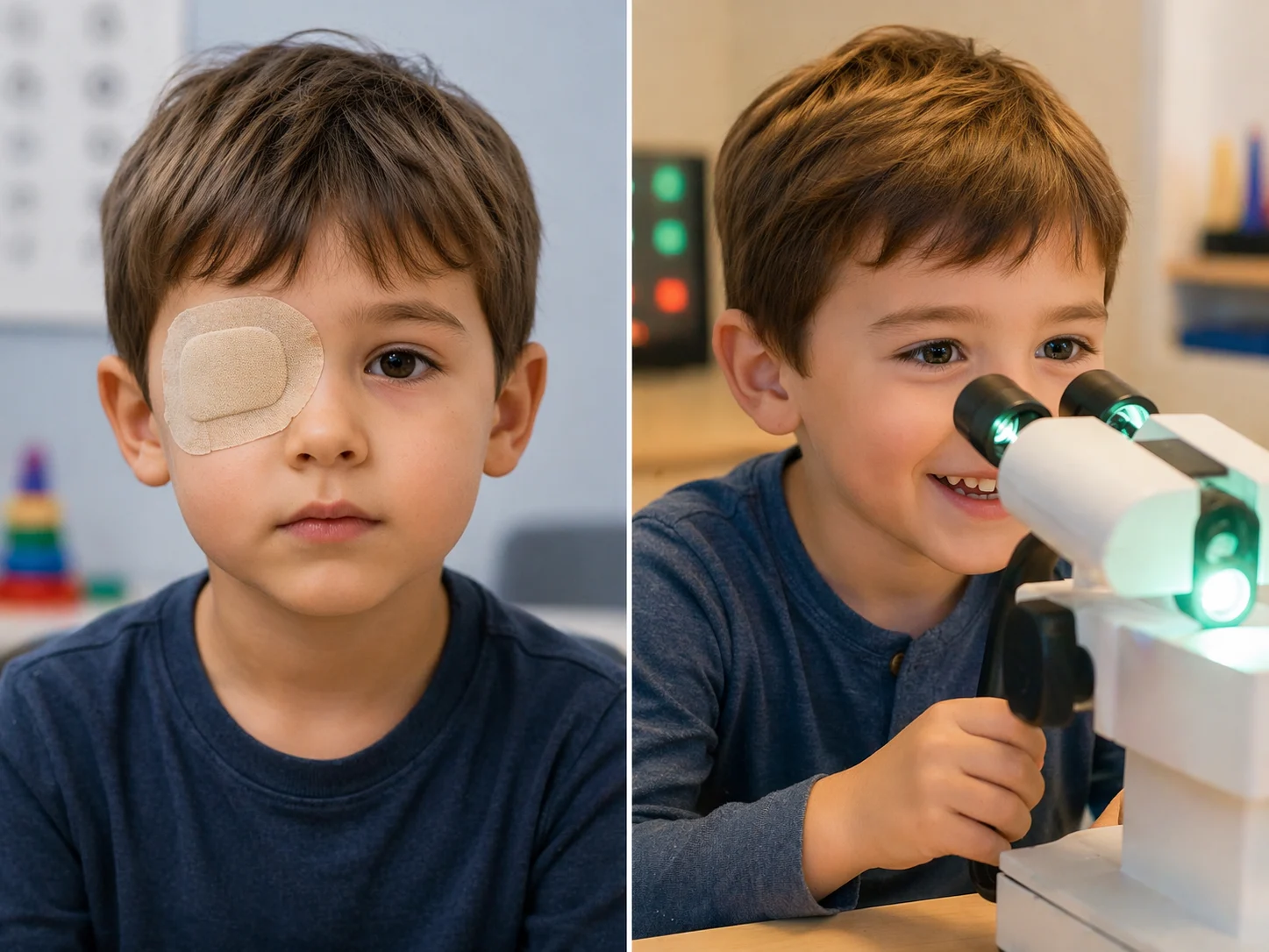
Patching can improve visual acuity (sharpness) in the amblyopic eye, and that is genuinely useful. But studies have consistently shown that patching alone rarely develops stereopsis (depth perception) or true binocular vision. Children who only patch often have two eyes that each see reasonably well, but that still do not function as a coordinated team.
High Relapse Rates After Stopping
One of the most frustrating things for families is seeing their child's vision regress after patches come off. This happens because patching relies on compliance and continued wear to maintain improvements. When the patch is removed, the brain often reverts to suppressing the weaker eye because the underlying binocular coordination was never properly established.
The Psychological Cost
Patching for hours each day is genuinely hard for children. It affects self-confidence, can interfere with school, and causes real friction at home. When families invest that level of commitment and still see regression, it is deeply discouraging. That emotional cost matters and it makes the question of whether patching alone is the right long-term strategy worth examining honestly.
What Vision Therapy Adds
Vision therapy for amblyopia addresses the whole visual system, not just the weak eye in isolation. A structured program works on three levels simultaneously:
Improving Visual Acuity in the Amblyopic Eye
Like patching, vision therapy stimulates the weaker eye. But it does so through active, engaging visual tasks that are calibrated to the child's level and progressed regularly, which tends to sustain motivation far better than passive patching.
Reducing Suppression
Suppression is the brain's way of ignoring the signal from the weaker eye to avoid confusion or double vision. Vision therapy specifically targets suppression using dichoptic techniques - presenting different images to each eye - to gradually retrain the brain to accept input from both eyes at the same time.
Building Binocular Vision and Stereopsis
This is the part patching cannot reach. Vision therapy trains both eyes to work together as a team: converge correctly, maintain alignment under different visual demands, and fuse images into a single, three-dimensional percept. Developing true stereopsis is what separates a functional outcome from just an improved eye chart score.
Does Age Matter for Amblyopia Treatment?
The old teaching was that amblyopia treatment only worked in children under 7 or 8, during the so-called critical period. That view has changed substantially in the last decade. Research now shows that the brain remains more plastic than we thought, and that meaningful improvements in amblyopia - including in adults - are achievable with the right approach.
That said, early treatment is still better. The younger the brain, the more readily it reorganises. If you have been told your child has a lazy eye, starting a proper evaluation sooner rather than later is worth doing. And if you are an adult who was patched as a child and never developed proper binocular vision, it is absolutely worth asking whether anything can still be done - in many cases, it can.
What to Expect from a Vision Therapy Program for Amblyopia
After a comprehensive functional vision evaluation to assess the depth of the amblyopia and the degree of suppression, a typical program includes:
- Weekly in-office vision therapy sessions (45-60 minutes)
- Daily home exercises on a tablet or computer using dichoptic games and activities
- Regular progress assessments to track acuity, suppression, and binocularity
- Lens or prism prescription where appropriate to support the treatment
Most children with moderate amblyopia complete an active treatment phase in 16-30 weeks. Progress is typically much more stable than with patching alone because the underlying binocular foundation has been built, not just the acuity score.
A Note to Parents
If your child has been patching for a while and you are not seeing the results you hoped for, or if the improvement keeps slipping back when the patch comes off, please do not blame yourself or your child. Patching is a legitimate tool but it is not the whole picture. A proper functional vision evaluation will tell you clearly where your child's visual system actually stands and what a complete treatment plan should look like.
We have worked with many children who had patched for years without developing proper binocular vision, and we have helped most of them make real, lasting progress. It is worth getting the full picture.
Learn more about our amblyopia treatment programme or book a comprehensive vision evaluation to find out where your child's vision really stands.