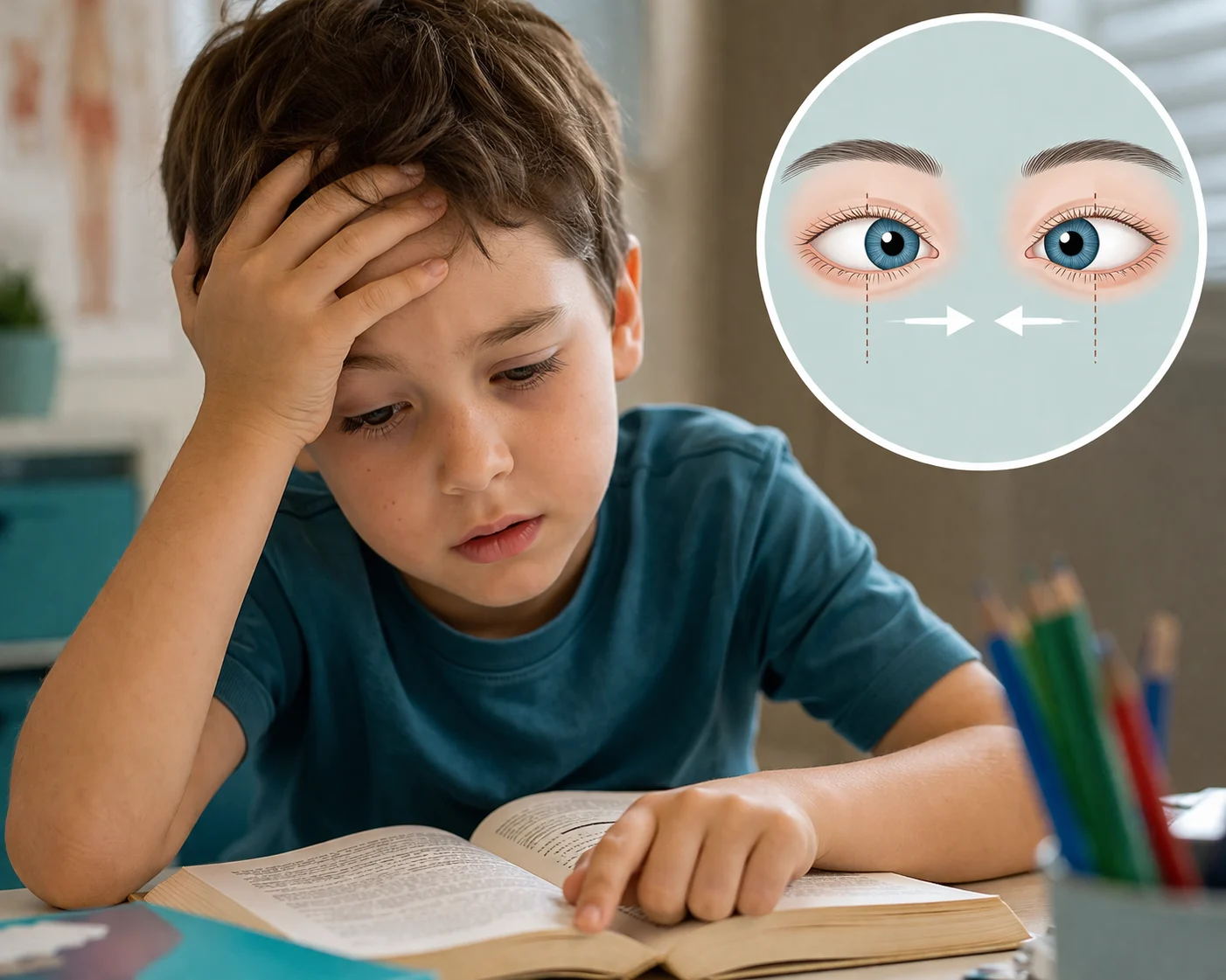
Your child reads perfectly well for five minutes, then starts rubbing their eyes, complaining of headache, or refusing to continue. Their teacher says they are bright but distracted. Their eye test came back normal. You are left wondering what is actually going on.
The answer, in a significant number of cases, is convergence insufficiency (CI) — the most common functional vision disorder affecting school-age children, and one that a standard eye examination almost never picks up.
What Is Convergence Insufficiency?
When we look at anything up close — a book, a tablet, a worksheet — both eyes must turn inward simultaneously to keep the image single and clear. This inward movement is called convergence. Convergence insufficiency is a condition in which the eyes struggle to maintain this inward alignment during near tasks. The effort required to keep the eyes teamed is either exhausting or ultimately unsuccessful, leading to a cascade of symptoms that make reading and near work genuinely painful.
It is not a problem with the eyes themselves. The eyes are typically structurally normal. It is a coordination problem — the visual system is not efficiently directing the two eyes to work as a team at near distances.
Symptoms Parents and Teachers Often Miss
Because CI does not affect distance vision, children pass standard school vision screenings and even basic optometry appointments without detection. The symptoms appear almost exclusively during sustained near work:
Reading and Learning Symptoms
- Headaches during or after reading, homework, or screen use
- Eye strain, tiredness, or soreness around the eyes after near tasks
- Words appearing to blur, move, or double on the page
- Losing place frequently while reading — skipping lines or re-reading
- Needing to use a finger to track across the page
- Difficulty concentrating on reading, even for short periods
- Covering or closing one eye to reduce discomfort
- Slow reading speed despite normal intelligence
Behavioural Signs That Can Be Misread
Many children with convergence insufficiency are labelled as inattentive, reluctant learners, or suspected of having ADHD. When reading is physically uncomfortable, avoidance is a rational response. A child who fidgets, gets up repeatedly, asks to do something else, or completes very little written work is often not misbehaving — they are trying to escape visual discomfort they cannot articulate.
Why a Standard Eye Test Does Not Detect CI
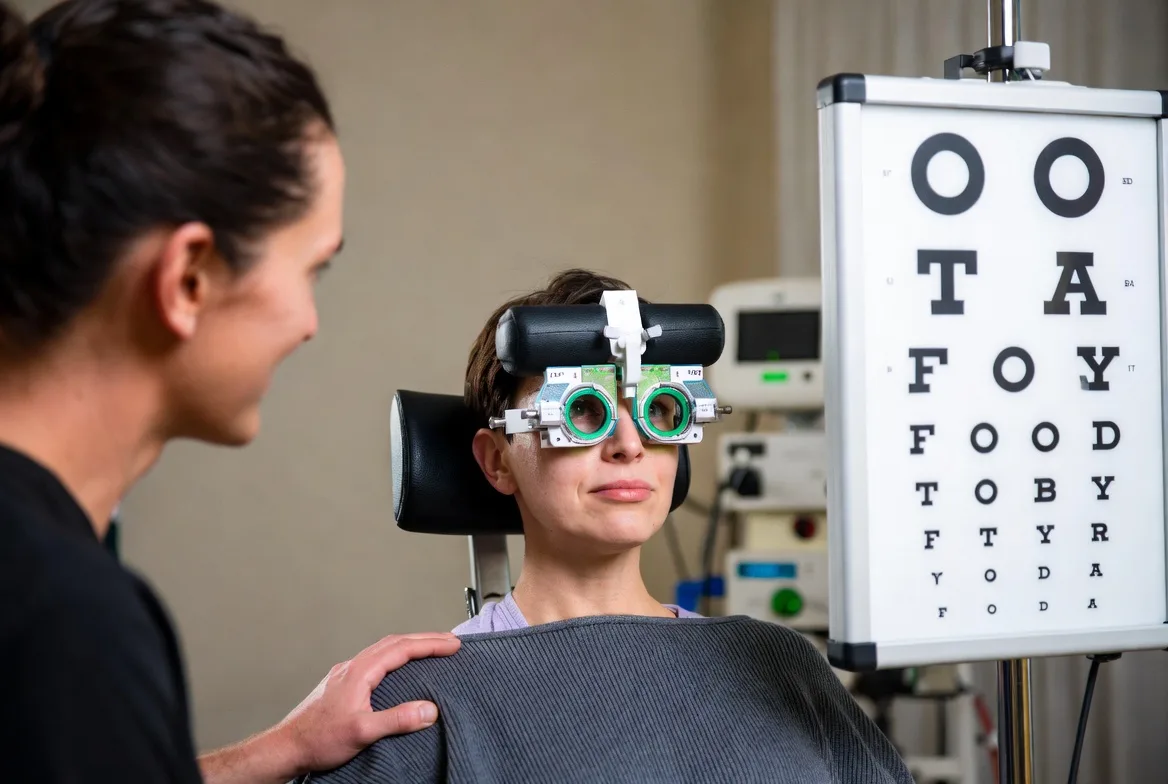
Standard optometry appointments measure visual acuity (the letters on the chart) and screen for refractive errors like short-sight and long-sight. They do not routinely measure convergence ability, near point of convergence, accommodative-vergence relationships, or binocular vision function under sustained near demand.
A child can have 6/6 (20/20) perfect distance acuity and still have significant convergence insufficiency that makes reading functionally difficult. This is why so many children fall through the gap — their eye health is genuinely fine, so nothing further is investigated.
A Functional Vision Evaluation is specifically designed to assess these binocular vision skills. It involves targeted testing of convergence range, vergence facility, accommodative function, and eye movement patterns — the skills that actually matter for reading.
How Common Is Convergence Insufficiency in Children?
Research consistently suggests CI affects between 5% and 10% of the school-age population. In a class of 30 children, statistically 2 to 3 are likely to have clinically significant convergence insufficiency. It is not rare. What is rare is that it gets properly identified and treated.
The Convergence Insufficiency Treatment Trial (CITT), a landmark multi-site randomised controlled trial funded by the US National Eye Institute, confirmed that office-based vergence and accommodative therapy is significantly more effective than home-based pencil push-up exercises or placebo treatment. Vision therapy is the evidence-based treatment of choice.
Vision Therapy for Convergence Insufficiency
Convergence insufficiency responds very well to structured vision therapy when properly diagnosed and treated. The goal of treatment is to improve the range, accuracy, and stamina of convergence — training the visual system to maintain comfortable, accurate eye teaming during near tasks without conscious effort.
What Treatment Involves
At Caring Vision Therapy, a CI treatment programme typically includes:
- Weekly in-office vision therapy sessions using specialised instruments and activities targeting vergence control
- Accommodative-vergence integration training to improve the link between focusing and eye teaming
- Optometric syntonics phototherapy where indicated, to support neurological visual regulation
- A tailored home exercise programme to reinforce weekly in-office gains
- Regular objective progress monitoring to track functional improvement
How Long Does Treatment Take?
Most cases of convergence insufficiency in children show significant symptomatic improvement within 12 to 24 weeks of structured in-office therapy. The CITT study showed that 73% of children treated with office-based vergence therapy achieved successful or improved outcomes, compared to 43% for home-based pencil push-ups and 33% for placebo. Outcomes vary based on severity, consistency of home practice, and individual response.
What Happens If It Goes Untreated?
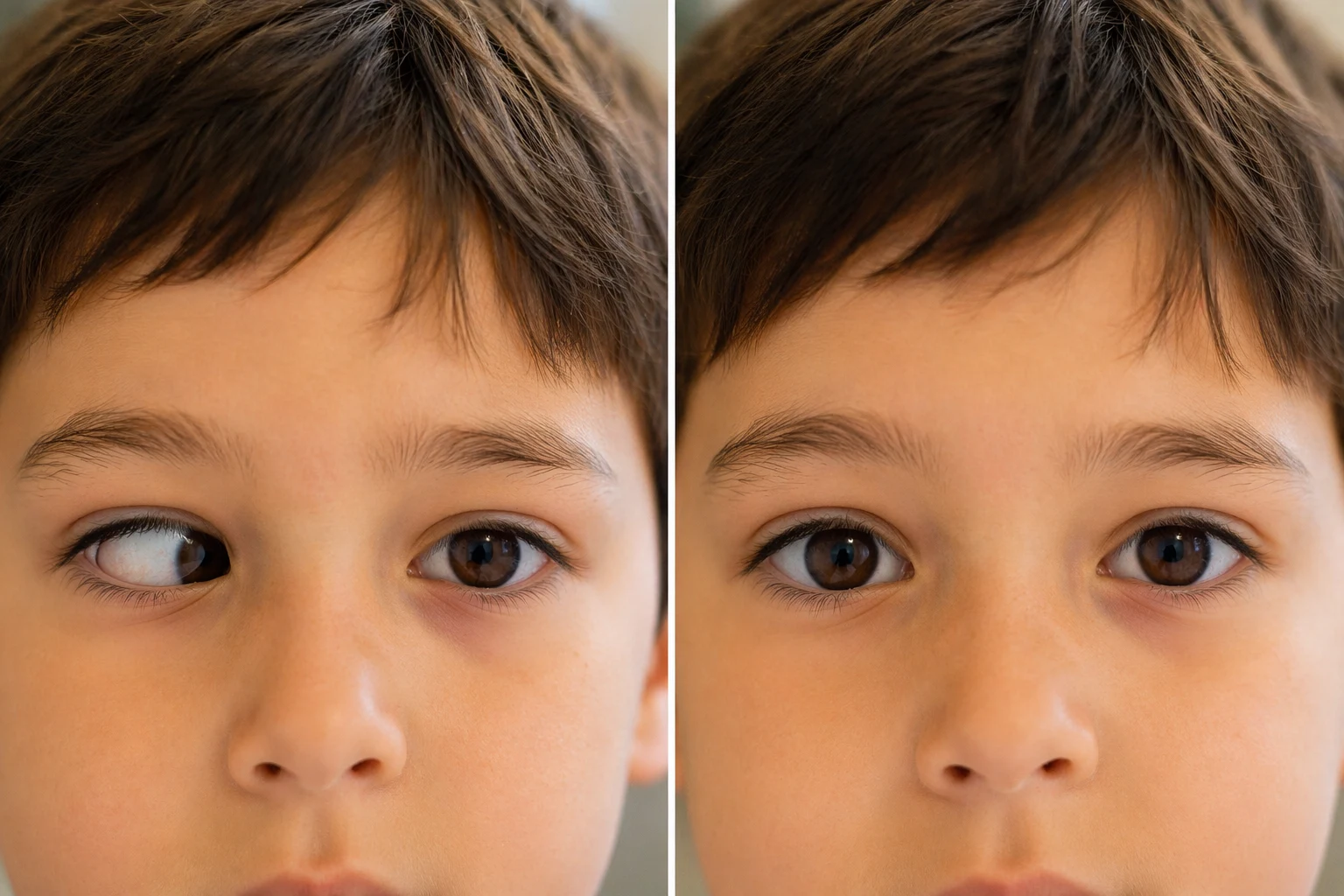
Untreated convergence insufficiency does not resolve on its own for most children. As academic demands increase — more reading, longer homework sessions, more screen time — the symptoms typically worsen. Children may develop avoidance strategies that affect their learning and confidence. Some suppress the vision in one eye to eliminate the effort of teaming, which can lead to secondary problems.
The good news is that CI is highly treatable. Early identification and structured therapy produce excellent outcomes, and children who complete treatment are often transformed in their ability to read and learn comfortably.
What Parents Should Do Next
If your child shows any of the symptoms described above — particularly headaches and eye strain during reading, losing place on the page, or avoiding near work — do not wait for the next routine eye exam. Request a Functional Vision Evaluation specifically. Make it clear that you want eye teaming and binocular vision assessed, not just acuity.
At Caring Vision Therapy in Chennai and Hyderabad, our COVD/OVDRA certified specialists conduct comprehensive functional vision evaluations designed to detect exactly these kinds of conditions. A proper evaluation takes approximately 90 minutes and gives you a clear, honest assessment of what is happening and what, if anything, needs to be done.
Learn more about our Convergence Insufficiency treatment programme or book a functional vision evaluation for your child today.